We are covered by a collective agreement. Does that settle pay transparency?
A collective agreement sets your pay scales. The directive also asks for categories of equal work, and no collective scheme delivers that layer.

Ready for the pay transparency rules, with a classification you can explain
We build your first job architecture of 3 roles for free: weighed on the four statutory factors, with a pay ladder and the reasoning for every placement. The pay justification document itself comes with the subscription.
It is the first reaction from almost every employer bound by a collective agreement: "our pay is already arranged, it is in the agreement." For the amounts, that is true. For the question an employee is about to ask, it is not quite.
The difference sits in two obligations that look alike but ask for different things. One is about your pay structure. The other is about sorting your people into groups that do equal or equivalent work. A collective agreement can settle the first. The second stays with you, collective agreement or not.
What the collective agreement does settle
A collective agreement gives you a complete pay framework. The grades are fixed, the steps are fixed, the amounts per step are fixed, and in many sectors it comes with a recognised job evaluation scheme: ORBA, ISF, CATS, or a scheme the bargaining parties had built for their own sector. Those schemes are carefully constructed and maintained by people who know the work. They answer one clear question: which grade does this job belong in?
That is not a small question, and it is not one you need to ask again. Where the agreement applies, the grades apply. There is nothing there to improve on and nothing to replace.
The explanatory memorandum to the Dutch bill says as much: the duty to have pay structures that ensure equal pay for equal or equivalent work (article 8(1)) can be met through a collective agreement.
The question that remains next to it
The obligation that follows is a different one. Article 10b asks the employer to establish categories of workers performing equal or equivalent work. That is the layer information requests land on: an employee will be able to ask for the average pay, broken down by sex, of the category they sit in themselves.
That step is separate from which grade someone holds. And it stays with the employer in every case, including an employer fully bound by an agreement. Bargaining parties may offer something here in future, but today they have not.
For what such a request looks like in practice, read what you have to tell an employee who asks what colleagues earn.
A pay grade is not a category
This is where things go wrong if you treat the two as one.
A category consists of workers performing equal or equivalent work. That is not the same as a job title, not the same as a department, and not the same as a pay grade. Two jobs can carry different titles and still be equivalent. And the other way around: workers can sit in the same grade without belonging to the same category.
The explanatory memorandum gives a concrete example: a photojournalist and a readers' editor, both placed at level 6 of the Dutch publishing sector agreement. So a single grade can hold several categories.
It runs the other way too. One category can contain workers covered by different collective agreements. If you have more than one agreement in the house, you cannot draw the categories per agreement, because a category cuts straight across them.
How to actually put two jobs side by side is worked through in when is work of equal value.
The four factors come from the law, not from a method
So what do you compare on? Four factors written into the law itself:
- Skills: education, experience, professional competence.
- Effort: physical and mental, the demand the work itself makes.
- Responsibility: what the job decides on, what goes wrong when it goes wrong.
- Working conditions: the circumstances the work happens in.
That has a practical consequence people often miss. For this layer you do not need a licence on an evaluation method and you do not have to apply a proprietary scoring table. The categories layer rests on the statutory factors and sits next to the scheme your agreement already uses. You are not replacing anything. You are adding a layer that is not there yet.
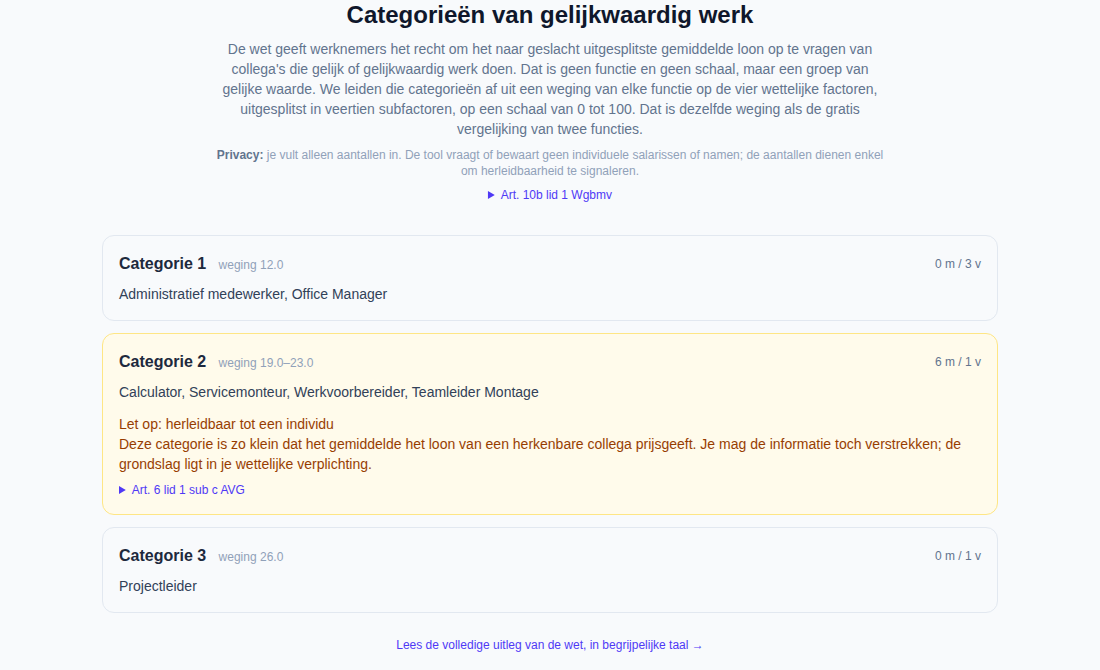
Categories follow from the weight of the job, not from the grade. The flag warns that a group is small enough for the average to point at one person.
That last warning is not a detail. An average over two people is no longer an average, it is a salary. So we do not show such a group as an average: below three people the figure stays hidden, and where needed the complementary group is suppressed too, so you cannot work it back out.
That is our own choice while building, not a statutory minimum. Do not confuse it with what you owe when an employee actually files an information request. The directive let member states restrict data on very small categories to worker representatives or the inspectorate, and the Netherlands did not take up that option. A small, traceable category is therefore no ground to withhold: you give the average and note that the group is small.
Your works council sits exactly on this layer
For an employer under a collective agreement this creates a sharp split, and it is worth knowing about in advance.
On the job evaluation and pay scheme, the works council has no right of consent as long as the agreement covers it. The unions sit at that table. But on establishing the categories of workers, the objective pay criteria, the pay reporting and the handling of unjustified pay differences, the works council is involved.
In other words: the exact layer your agreement does not deliver is the layer your works council gets a say in. That makes the reasoning behind each placement more important than the placement itself. "That is what the scheme said" is not an answer there.
The second check: is every job still in the right grade?
There is one more reason a collective agreement does not finish the job, and this one is about practice rather than method.
The Netherlands Institute for Human Rights, which rules on these cases, also looks at how a job is actually performed. So two employees can be graded differently while doing equivalent work in practice. That rarely happens on purpose. It happens because someone picked up tasks over ten years and the job description was never updated.
That is exactly the report an employer with a collective agreement comes to us for. You fill in, per job, the grade it sits in today. We weigh the same jobs independently on the four factors and place them in your existing ladder, so with your own amounts. Then we put the two classifications side by side and show where they part ways, biggest gap first.
One design choice matters here: the grade you enter never goes into the weighing. If the model knew where a job already sits, it would put it back there, and the comparison would measure nothing but our own echo. The placement has to come out of the weighing, or the difference means nothing.
A gap is not a verdict. There can be a good reason for it, and you are free to write that reason down. But you want to know about it before an employee asks.
What the SZW guidance says here, and what is left to you
On 15 April 2026 the Dutch Ministry of Social Affairs and Employment published guidance on pay structures, written by the Verwey-Jonker Institute. It matters for employers under a collective agreement, because it is outspoken on exactly this question.
The first thing it says is reassuring: employers who outsource job evaluation to a recognised system holder, such as ORBA, FWG, the Hay method, CATS or FUWASYS, broadly meet the directive according to the guidance. So there is no reason at all to replace your existing system, and be sceptical of anyone trying to sell you that.
The second thing is less reassuring, because the guidance leaves three standing tasks with you that nobody else will do:
- Describe, weigh and place every new job. This is the task that comes round most often, because a growing organisation creates a new role several times a year. The guidance requires that all jobs are evaluated by the same method, so bolting a new one on separately is not an option. And since the grouping into categories is what you established with your works council, adding a job to it is not a neutral administrative act.
- Update your job descriptions every two to three years. The evaluation rests on the description. If the content of the work changes and the description does not, you are evaluating something that no longer exists.
- Repair differences between jobs valued the same. If two jobs come out at the same value but sit in different grades, you are expected to avoid that or to make a plan to correct it.
That is not a project you tick off once. It is work with a frequency, and it is exactly the part your collective agreement does not do for you.
What you can do now
- Keep the two obligations apart. Your pay structure comes from the agreement. Your categories you draw yourself.
- Weigh your jobs on the four statutory factors, independently of the grade they sit in.
- Put the result next to your current classification and note the reason for every difference.
- Involve your works council in the categories and the criteria, not only in the outcome.
- Agree who describes, weighs and places a new job before the first one arrives. That moment comes round sooner than the three-yearly refresh.
The Dutch bill (parliamentary document 36949) is with the House of Representatives and has not been passed. The House debates it on 7 December 2026 and 11 January 2027, which makes the intended 1 January 2027 start tight; a later date in 2027 is likely. Other member states are implementing the same directive on their own timelines, so the two-layer structure travels even where the wording differs.
Put your own classification next to it
We build your first job architecture of three roles for free, inside your own collective pay ladder: the weighing on the four factors, the placement, the categories of equivalent work, and per role the reasoning for why it sits there. Add the grade it holds today and you see straight away where the two diverge. All of that is on your screen. The pay justification as a PDF, the document you hand to your works council or to an employee, comes with the subscription.
Build your first three roles for free or compare two roles first
Aycabtu delivers the weighing, the categories and the documentation underneath. Whether that gets you to all of your obligations also depends on what you do with your pay and on the rest of your duties. This article is information with sources, not legal advice.
Try it
We build your first job architecture of 3 roles for free: weighed on the four statutory factors, with a pay ladder and the reasoning for every placement. The pay justification document itself comes with the subscription.
Build your job architecture →Ready for the pay transparency rules, with a classification you can explain
We build your first job architecture of 3 roles for free: weighed on the four statutory factors, with a pay ladder and the reasoning for every placement. The pay justification document itself comes with the subscription.
Build yours for free